

Crank Arm Lengths
Some people believe that the choice of crank length should be based purely on function e.g. 175mm for Mountain bikes and 165mm for the track. A brief perusal of various cycling forums will usually find ambivalence to crank lengths with various comments such as 'I've got 170mm on one bike and 175mm on the other and can't tell any difference between them'. One could also suggest the cycling industry is indifferent to crank length as the range of available sizes is quite narrow, often just 170-175mm. If we look at the crank sizes fitted to bikes sold in the UK, the majority are now on 172.5mm.
Having been a Bike Fitter for some years now, I am of the opinion that your crank length can be the second most important dimension on a bike after saddle height. This may seem incredulous to some, especially if you can't tell the difference between 170mm and 175mm, which may well be true if you are around 1.83m (6') tall. The shorter you are, the more likely it will be that your cranks are too long and that you have been let down badly by the cycling industry.
To understand the extent of this problem, let's assume that the 172.5mm cranks fitted as 'standard' on the majority of bikes sold in the UK are suitable for an average height male of 1.778m (5'10"). We can then consider 'why' they are suitable and conclude that the range of motion at the hip, knee and ankle joints are appropriate, along with the commensurate muscle contraction rates to generate power comfortably and efficiently. The joint ranges of motion will be dependent upon the femur, tibia and foot length, which vary (usually) in proportion to your height. So in simple terms and assuming we all have similar proportions we could use our 172.5mm cranks and 1.778m height to suggest crank lengths should be 9.7% of our height.
Rounding to the nearest size:-
| Height | Crank Length(cm) |
|---|---|
| 6'0" (1828mm) | 177.5mm |
| 5'11" (1803mm) | 175mm |
| 5'10" (1778mm) | 172.5mm |
| 5'9"(1753mm) | 170mm |
| 5'7" (1702mm) | 165mm |
| 5'5" (1651mm) | 160mm |
So given that 172.5mm cranks are fitted on nearly all 54 size bikes, plus quite a few 52's, and you will only find 165mm cranks on small ladies bikes, either most of the cycling industry is getting this wrong or there is some error in these numbers!
Replacing cranks can be expensive, so as a Bike Fitter, I need to be able to be able to recognise problems due to incorrect length and make suitable recommendations without incurring unnecessary expense. To help form my own opinions I have looked to three resources.
1) Published reports, data or recommendations.
2) Going back to first principles.
3) Using the data and feedback from BikeDynamics customers.
1) Published Reports and Recommendations.
A quick internet and literature search on optimum crank length will reveal a number of sources of information.
You will find a crank length calculator here Machinehead-Software.co.uk which uses the formula 1.25 * inseam (in cm) + 65.
An excellent summary can be found at Myra-simon.com/bike/cranks including a table of crank length recommendations vs. Inseam provided by French manufacturer Specialites TA.
In his recent book The Obree Way, Graham Obree discusses his preference for 170mm over 172.5mm cranks and proposes using the formula Crank length = 9.5% height.
There are interesting articles here:
cobbcycling.com/articles/crank-length-coming-full-circle here www.powercranks.com and FSA kindly acknowledge my contribution here www.fullspeedahead.com/crank-length-matter
Other articles tend to support the argument that there is no definitive scientifically proven recommendation and you should use what 'feels best'.
We can take all these numerically based recommendations including the 9.7% of height established earlier and plot them on the same graph. We can also plot the implied crank length recommendation from bicycle manufacturer Felt. I'm not picking on Felt Cycles here, in fact the contrary as I'm a fan of their range of bikes and particularly like the sizing information they have on their website. It is because they give such good information that I can deduce the crank length vs. height relationship they suggest for their road bikes. Felt are by no means unusual, fitting similar length cranks to nearly everybody else, so I believe it is safe to call this the 'Industry Standard'. For convenience, I've used average male proportions to scale inseam up to height.
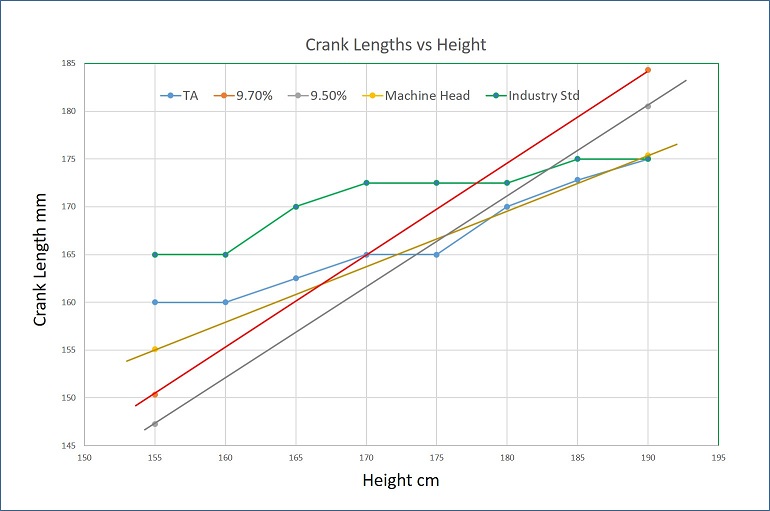
Unsurprisingly, the only height at which there is any sort of agreement between the Industry Standard and recommendations is around 180cm or 5'11". As a rule the recommendations are nearly always shorter than the actual crank lengths fitted by most manufacturers! You will note that there is good agreement between the Machine Head calculation and the TA recommendation.
2) Going Back to First Principles
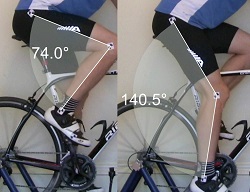
Knee Extension
The knee maximum and minimum angles are our first consideration. Trying to extend the knee maximum angle beyond a particular point will increase discomfort and lose power, so best avoided. The knee minimum angle is also important as the tighter this gets, the higher the shear forces in the knee joint and the less efficient the quads are in pushing the foot forwards over the top of the stroke. There is often a 'double whammy' as longer cranks mean the saddle needs to be lower to enable suitable leg extension. A lower saddle combined with longer cranks will quickly tighten the minimum knee angle.
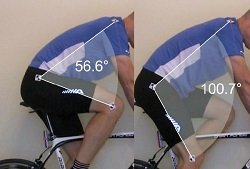
Hip Angles
Dynamic hip extension is well within our range of movement, especially as cyclists tend to lean forwards at the hip. Hip flexion is far more relevant and if too tight, power is lost and discomfort increases. Rather than minimum hip angle, it may be easier to think of this as the height of the knee as the foot passes over the top of the stroke. Too high and you will feel like you are kneeing yourself in the chest. A lack of flexibility in the hips will couple hip rotation with flexion, so the knees are pushed outwards as they approach the chest.
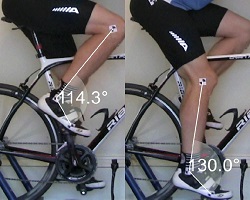
Ankle Angles
The ankle will typically dorsiflex on the upstroke, then plantar-flex as the legs extend. The 15.7° range of motion shown on Mr Average here is quite typical (usually 15-20° ) but there is far more diversity in what people do with their ankles than any other joint. There are a number of very successful cyclists with a very toe down posture, whereas others have relatively low heels. Longer cranks will tend to require either more dorsiflexion, plantarflexion or both.
Movement of the human body can be considered as similar to fluid flow, always finding the easiest route. From the fully extended to fully compressed leg position, the pedal spindle on our average 172.5mm cranks will move through a circumference of 1083mm and be 345mm closer at the top than the bottom. The dynamic stiffness and damping characteristics of each joint and muscle group will define how that displacement is distributed through the body. If the ankle, knee and hip joint can't accommodate the total range of motion, the only option is for the hip joint to move either up or down. Excessive hip rocking is often associated with a high saddle, but just as likely with both low saddles and long cranks.
Up to now, we have kept things simple by correlating crank length against height, but in reality we should use leg length. Dividing your inseam by your height is a good indicator and shows considerable variability from person to person. My measurements suggest the male and female average is 46.5%-47%. These are all taken wearing cycling shorts, so may differ from other published data. It may only seem like a small percentage change but 44% people are noticeably long backed, whereas 50% is very long legged.
3) Customer Experience
Everybody who comes to BikeDynamics for a bike fitting receives a crank length recommendation. As I could not possibly stock all the variations of size, type, gear ratio and bottom bracket compatibility, it is rare for me to fit new cranks here. So there is no profit motive to suggest alternative cranks, only a desire to do the best for my customers.
The recommendation is based on a number of factors. Any history of back, hip, knee or ankle discomfort is important, as are the relevant metrics such as knee angles, hip displacement. and ankle articulation. Pedal stroke analysis (Computrainer Spinscan) is also used, but with caution as we need to separate poor technique from a fundamental inability to cycle efficiently due to the wrong length cranks. One strong indicator is the width of the suitable saddle height 'window'. Tall people with relatively short cranks will have a wide saddle height 'sweet spot', where a change of a few mm in either direction makes little difference. If the cranks are too long, there is often an extremely narrow window, where even a 1-2mm higher or lower saddle is noticeably worse. As this could be similar to a thicker pair of cycling shorts, reducing sensitivity by fitting shorter cranks is likely to be beneficial.
The best indicator of suitable crank length is the feedback I get from customers who have changed them based on the outcome of a fitting. As a rule everybody appreciates the change, with some fantastic improvements to performance and comfort. See Case Studies below. Some people appear to cope very well with cranks that would appear to be too long for them. As a rule they tend to be quite flexible with good core strength. If such people have good pedalling technique, no discomfort and strong power delivery, then why change?
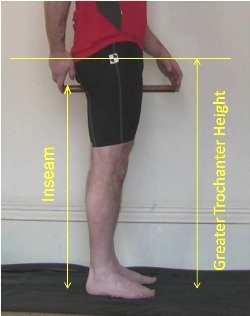
Leg Length Measurement
Taking all of the above into consideration, I can plot the crank length recommendation for each customer against their inseam. Developing similar correlations for saddle heights has indicated that inseam is not always the best means to define leg length. People can have either a relatively shallow or deep pelvis. If you consider the top of the leg being the centre of the hip ball joint, a deep pelvis means the leg starts much higher than the inseam suggests. An alternative leg length measure is to the top of the Greater Trochanter (GT), which is a good representation of the centre of the hip joint.
There has to be some manipulation of the data, mainly because the high number of customers coming in with 172.5mm cranks will tend to skew the result. I am also aware that whereas it is very easy to find evidence to recommend shorter cranks, there are no strong indicators that they are too short. I also find it hard to make recommendations for cranks that are either so long or short that they are very hard to come by.
Taking all of these factors into account, I can select the most appropriate data and plot recommended crank length against both Inseam and GT height. The regression curves generated are 'ok' and for those that know their stats have R2 values of 0.89 and 0.90 for inseam and GT respectively. The very best correlation is achieved against a simple addition of Inseam + GT height. One could imagine how this might be so as the GT height is clearly related to femur length, but your inseam influences how and where you sit on the saddle. In this case the best correlation is for a polynomial expression and has an R2 of 0.953. Converting this back into height and plotting against Industry Standard, Machine Head and 9.7% gives the plot below.
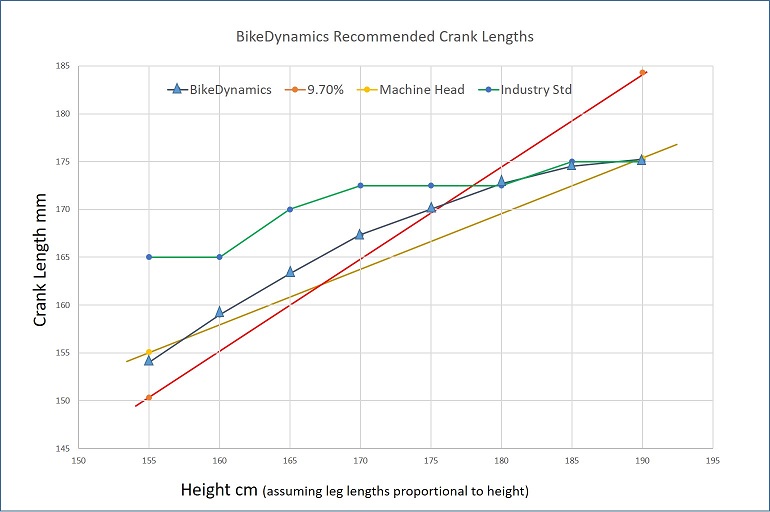
The BikeDynamics recommendation is always below the Industry Standard for everybody except the extremely tall and those of 180cm (5'11") where it matches exactly! If you really want to calculate your perfect crank length use this formulae
Crank length (mm) = -0.0123x(squared) + 4.8121x - 293.8
where x = (inseam + GT height) in cm.
Otherwise use the table below. There is very little downside to shorter cranks, so if you find yourself on the cusp between two sizes, always go for the shorter length. 162.5 and 167.5mm are quite rare, so in both cases you may find your best option is to go with 165mm.
| Crank Length(mm) | Inseam(cm) | GT Height(cm) | Inseam plus GT Height(cm) | Height, Male and Female* |
|---|---|---|---|---|
| 162.5 | 77 | 86 | Up to 163.4 | Up to 166.3 cm Up to 5' 5" |
| 165 | 77 - 79 | 86 - 88 | 163.4 - 167 | 165 - 170 cm 5' 5" - 5' 7" |
| 167.5 | 79 - 81 | 88 - 90 | 167 - 171 | 170 - 173 cm 5' 7" - 5' 8" |
| 170 | 81 - 83.5 | 90 - 93.3 | 171 - 177 | 173 - 179 cm 5' 8" - 5' 10½" |
| 172.5 | 83.5 - 86 | 93.3 - 96 | 177 - 182.5 | 179 - 185.5 cm 5' 10½" - 6' 1" |
| 175 | 86 - 89.5 | 96 - 101 | 182.5 - 189 | 185.5 - 192 cm 6' 1" - 6' 3½" |
| 177.5 | Above 90 | Above 101 | 189 + | Above 192 cm Above 6' 3½" |
* Assuming average leg length proportions for your height.
Update - Saddle Height change with crank length
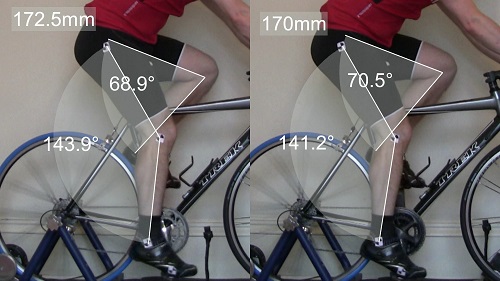
Many people rightly assume that if you change your crank length, the saddle height will also need to change accordingly. The usual assumption is that as cranks shorten, the saddle height can go up by a similar amount. This sounds entirely intuitive as saddle height is often defined as the extension of the leg and shorter cranks will result in less extension through the bottom of the stroke. My experience of fitting many people before and after crank length changes is that this is not always the case and depends how you set your saddle height in the first place. An ideal saddle height is in a narrow window or 'sweet spot' between being too high and too low. If you have found this spot, either through trial and error or a good Bike Fitting, the likely scenario is that changing your crank length will result in no requirement to change the saddle height. Essentially the sweet spot is in the same place! There are plenty of exceptions to this though, often caused by excessively tight hamstrings, quads or glutes compared to the other muscle groups. If changing your cranks, which in most cases involves going shorter rather than longer, my recommendation is to leave the saddle height alone initially. Then after 200-300 riding miles to adapt to them, experiment with nudging the saddle up or down 2-3mm to see if it feels any better. The knee extensions shown here are altered solely by a change in cranks, with both maximum and minimum angles coming into suitable ranges as the cranks shorten.
Case Studies
As a rule, most people appreciate the change to shorter cranks, usually finding a smoother more powerful pedal stroke and improved comfort. A few notable case studies are as follows.
Simon C.5'6" (167.5cm) tall with normal proportions, riding a TT bike with 172.5mm cranks very competitively. Highly flexible and appeared to cope with long cranks with extremely high levels of ankle articulation (37° range of motion) and a slightly high saddle. No major discomfort other than some saddle discomfort and occasional calf cramps. He had an excellent pedal stroke with no apparent inability to push forwards over the top of the stroke or pull back at the bottom. Initially there was no strong desire to change what appeared to be working well. Assessing 165mm instantly gave an improved saddle comfort with no apparent loss of power. Currently adapting to the new crank length and working toward the Triathlon World Championships.
Alan D5'7" (170cm) with short legs for height (74.8cm), had recently bought a new bike and started to experience hip pain. He had traded in his (pain free) old bike, so was not aware of the crank lengths on that bike. The new bike was a 52, so a suitable size for him other than it was fitted with 172.5mm cranks! Alan struggled to accept that a major bike manufacturer would fit unsuitable cranks, so assumed his hip problem was something to do with the compact frame geometry, got very frustrated and ended up selling the bike.
Chris Hartley and David WentworthChris 5'7", having turned 50 was sure that his best time trialling days were behind him, but still enjoyed the sport. Troubled by hip pain he turned to both medical help and a bike fitting in an attempt to improve the situation. Swapping from 172.5mm to 165mm was one of a number of changes that saw him go under the hour for a 25mile TT, the first time ever and a lifetime personal best. Chris' friend and fellow tester David Wentworth, having seen Chris's improvement, shortened his cranks and came in for a fitting to tune the rest of his position. The 2013 season saw him break both his 10 and 25 mile lifetime personal bests, fantastic achievements as he approached his 60th birthday.
Paula RPresented for a fitting due to knee pain, limiting her riding to no more than 20 flat miles. The diagnosis was a combination of a low saddle and long cranks conspiring to generate high knee joint shear forces. Paula did not change the cranks straight away, but immediately saw the benefit of the higher saddle with much improved knees. Confident that I knew what I was talking about, she did her own research on crank lengths and concluded that hers were in fact too long and waving my fitting report, took the issue up with her bike shop (a Big Brand Concept Store). They suggested that their fitting 'expert' was an ex pro and that my report was not worth the paper it was printed on! Paula subsequently found a crank length guide on the brands own website that contradicted what was fitted to her bike and agreed with my recommendation. The store changed her cranks, lost a customer and are probably not too fond of me! Paula was thrilled to finish her first 100 mile hilly sportive in 2013.
Mike Veal (Myself) 5'7"I used 170mm cranks for years until starting this research in 2010, realised they were too long and swapped for 165mm. I made what I now know to be the mistake of modifying my saddle height at the same time and took a short time to get it back to where it should be. I then really started to appreciate the change with a noticeable improvement to lower back discomfort on the bike and hill climbing ability. Subsequent experimentation with 167.5mm initially looked promising during rides up to 50-60 miles, but uncharacteristic cramping and inferior climbing over longer hillier rides soon pushed me back onto 165mm. The formula above applied to my own leg lengths suggest 166.6mm cranks! I Looked to see if Rotor Rings would ameliorate the downside of longer cranks, but concluded not, cranks are cranks.
On the Road Indicators.
Indicators your cranks are too long.
You feel your upper body 'bobbing' vertically when spinning fast and lightly loaded.
Your transmission occasionally 'clangs' as you hit a dead spot at the top of the stroke.
You prefer a low cadence i.e. 75rpm or less.
Your knees / hips / lower back hurts.
Your knees come uncomfortably close to your chest when on the drops or tri bars.
Indicators your cranks are too short.
DIY Dynamic Bike Fitting
You may be interested in our downloadable DIY guide.
49 Page PDF download describing all the observations, simple measurements and calculations required to do your own Dynamic Bike Fits.
Revision 2 released May 2020.
Contains updated male and female saddle height calculators and new information on male / female leg length proportions. Plus a new section to assist with saddle choice and improving comfort.
British Pound, Euro and US Dollar payments are processed by PayPal and all major credit cards are accepted. You will receive an email confirming your payment and will be automatically redirected to a page where you can download the ebook. The ebook is in PDF format so you will need to have a copy of Adobe Acrobat Reader or a similar PDF reader to read the ebook.
 £3.99
£3.99
€5.00
$5.00